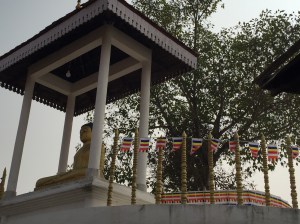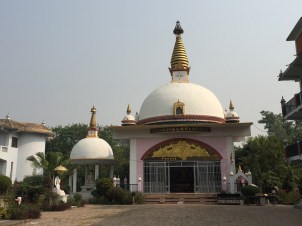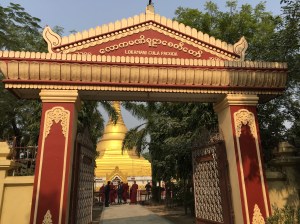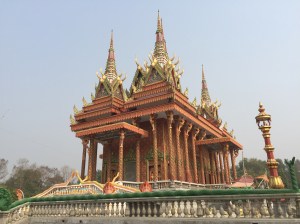
Week 201 February 3, 2018

Please excuse this post being late – we had only weak or insecure internet until today…

It is summer in Aotearoa – New Zealand, in Maori, pronounced ow-ah-tea-ah-row-ah. With us being from California, our experience is different from what we are finding here, especially Loren who is a California native. Instead it often feels more like my native New York for the clouds, thunder, lightning, rain, humidity. Our backpacker motel owner calls rain “liquid sunshine.” Unlike New York, the temperature cools in the evening, more like California. It just does not pay to have expectations – this is summertime in Aotearoa!

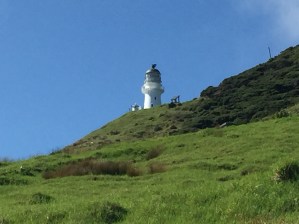
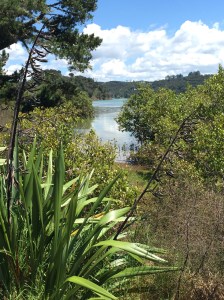
Still in Paihia on the Bay of Islands towards the north end of New Zealand’s North Island, Loren and I began this week with hiring a water taxi for transport to Deep Water Cove. Our driver – or maybe you would say pilot? or captain? – after acquainting us with his company, Wai Not – sounds like why not, with wai meaning water, and of safety on the boat, spoke a while in Maori which included singing a short song. He said that basically meant, “Hello!” and that the song part was a tradition of welcome. He asked us – being his only passengers, for a song in return. We were stumped in the moment to think of one, so he prompted that he likes Michael Jackson from the US. I came up with mostly humming part of MJ’s version of Turner and Parsons’ Smile, which he appreciated. 

We also learned from him that there are 139 islands in this bay. And, he explained “The Polynesian Triangle” as Maori people are originally of Polynesia heritage before settling on New Zealand. Loren and I discovered that we actually have been to two thirds of its boundaries, as we have visited Hawaii previously and now New Zealand. Sometime we hope to complete the triangle by traveling to the third point, which is Easter Island.

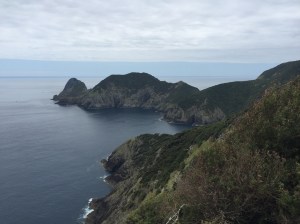
From Deep Water Cove Loren and I made what we thought would be a mild “2.5 hour walk”  for an overnight stay at the Cape Brett Lighthouse hut. In fact the writeup said, “Walk to the hut via the undulating Cape Brett Track,” “through native and regenerating bush” with “dramatic coastal views.” However, we must have overlooked the parts that included, “The Cape Brett Track traverses rugged terrain” and other menacing phrasing, for it took us 4 hours over the steep up and down over several narrow ridges. We made it though, and spent the night in dorm style accommodation with nice people – 2 young women from Auckland, a young Canadian couple and a young man from Wisconsin. We made the return hike to the Cove in just slightly less than 4 hours, and even enjoyed the tramping after the fact. As Loren says, we collected another memorable experience. 
IMG_2652.jpg IMG_2658.jpg

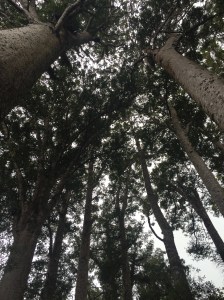
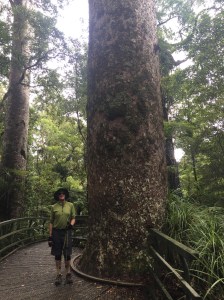
We had a final full day of sightseeing at Bay of Islands: first with viewing Rainbow Falls, then a short walk through a lovely Kaori rainforest, and, stopping to see Haruru Falls. We spent the rest of that day at Waitangi Treaty Grounds, where we learned more of how the Maori chiefs and British crown representatives forged an agreement of partnership in 1840. We had a guided tour, saw a cultural performance and a Maori concert, and, ate a traditional Hangi dinner. A Hangi seems similar to an Hawaiian Luau. And some Maori words seem strikingly similar to Native American words. I marvel at that coincidence.
IMG_2678.jpg IMG_2679.jpg

We then drove south through Auckland on our way to Rotorua – said row-tow-rue-ah, on the Bay of Plenty, actually a bight. I am learning a bit about different coastal landforms with all the shorelines of New Zealand. I grew up near Long Island Sound, but now have realized that I had no idea what characteristics make up the category of a sound. Here is a sound-bight of what I have found:

     a bay has a wide mouth, partly surrounded by land on three sides
     a bight is a shallow curve but less curvature than a bay or a sound
a cape extends far into a body of water with water on two sides
     a cove is a sheltered, small inlet, often found in a larger bay
an estuary is where a river meets the sea forming brackish water
a fiord is a narrow, long, steep-sided valley created by a glacier, filled with water
a peninsula is bordered by water on three sides
a sound is a large inlet wider than a fjord, and often separates land from an island

Now I am curious about the name Bay instead of Bight of Plenty? And, Long Island by the way, was deemed by the US Supreme Court in 1985 to be not an island, but a peninsula!

We stopped after Auckland on our continued way to Rotorua for an inspiring tour of Hobbiton, the enchanting place where Lord of the Rings and The Hobbit Trilogies were filmed. We later wanted to walk around some of Lake Rotorua, and drove to where we happened to find a tribute to John Lennon’s Imagine, but, it was dreary and overcast, too blustery to enjoy the evening out and about in the elements. 

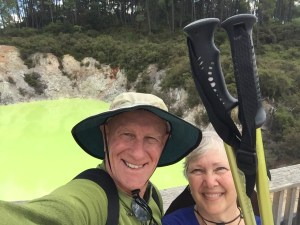
Another full day was spent starting with a morning at Wai O Tapu – meaning sacred waters, a geothermal adventure. Our time included viewing the Old Faithful-like Lady Knox geyser and some outstanding colorful pools, caves, and geysers. It all reminded both Loren and me of our respective visits to Yellowstone National Park 43 and 45 years ago. Loren’s shirt that day and his hiking poles matched one pool named “Devil’s Bath.” What was also intriguing here were the mud pools. I think everyone who witnessed their frequent quick unpredictable “Bloop!” – what Loren called the audible shows they make, could not help but smile. 

Frame-08-02-2018-12-08-24.jpg IMG_2738

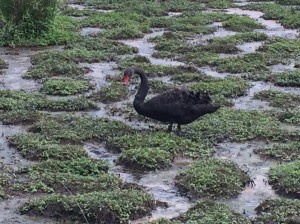
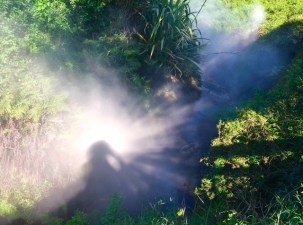
We spent that afternoon at two lakes. Okareka – Lake of Sweet Food, was serene and featured a multitude of black swans. Tikitapu – Blue Lake, being a haven for swimmers, suited Loren to jump in. We finished the day with an evening spa at Waikite Valley, which translates to clear water. As my name, Claire also means clear, I would like to take the Maori name, Kite – said key-teh. We also took an “eco-walk” to see 40-50 gushing liters of boiling water per second, so hot that it must be cooled before entering any of their six pools. The steam combined with the sunlight made for an interesting photo.
IMG_2754.jpg IMG_9888.jpg

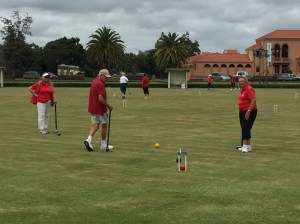
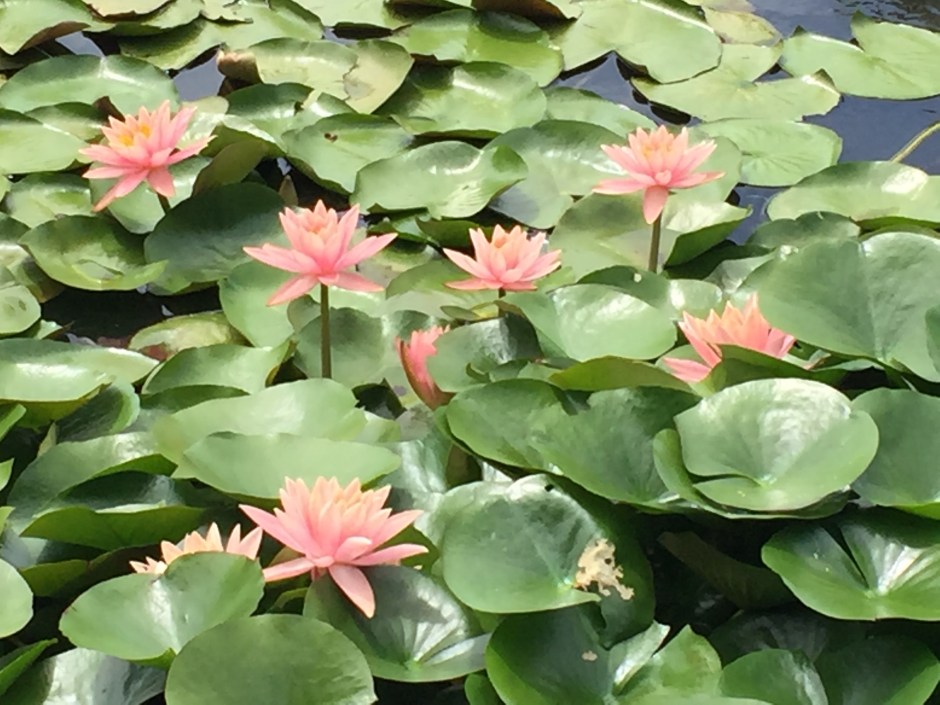
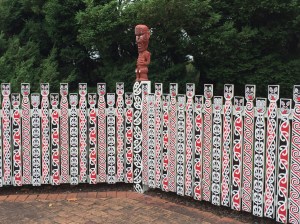
Before leaving Rotorua, we stopped briefly at Government Gardens. It was nice to see a bit of Maori history honored with displays, a nice surprise to find folks playing croquet on the lawns, and nice to enjoy a vast array of blooms. 
IMG_2770.jpg IMG_2780.jpg IMG_2782.jpg

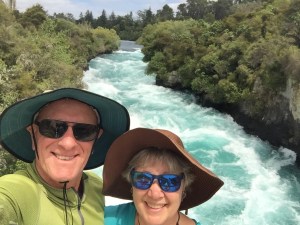
We then stopped to see Waikato River’s Huka Falls, which reminded me of a favorite color of mine as a child – Sea-Foam-Green. Given that this day my shirt matched the waters, perhaps it still is a favorite color

IMG_2799.jpg

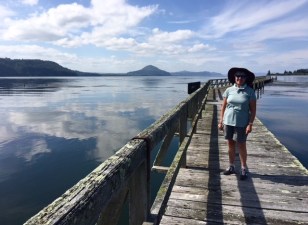
From here we drove to see Taupo Lake where we enjoyed a walk on an old wharf before arriving at our AirBnB accommodation in a barn with upstairs living space. Our host joined us for a glass of wine and we learned that the name she chose for her retreat -Rangimarie, means place of peace. We enjoyed a peaceful down day staying out of the heavy-at-times-rain, listening to the pattering and pouring on the roof all day long in her delightful lodging. That evening we shared conversation and dinner in her lovely home.
IMG_0045.jpg IMG_2870.jpg

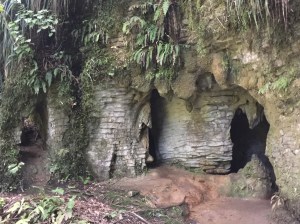
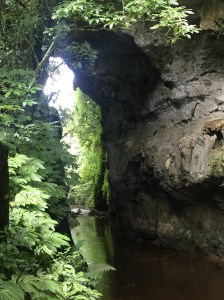
The next day we were back on the go, with Loren taking a 3 hour “glow worm” cave tour by inner tube in a wet suit, while I took tours by foot and boat during the same time to see the unusual creatures. Afterwards together we hiked to see more caves in the Waitomo area – meaning hole made by water. Then we visited a nearby natural bridge.

IMG_2827.JPG IMG_2849.jpg IMG_2859.jpg

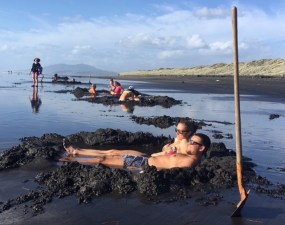
We were fortunate in the timing of low tide at the harbor where we were able to dig in the sand and have a soak in a natural hot pool. That is me standing where Loren would soon dig. Another wonderful week, full of fulfillment. We are so grateful for our Journey, for our family and friends who support us by keeping in touch as best we can, for all the wonderful people we are meeting, and for all that we are learning, seeing and doing. We finished the day and this week with a dinner of locally acclaimed fish ‘n’ chips. Good fun!
IMG_0142.jpg IMG_2861.jpg


Week 200 (!) January 27, 2018

Last week Loren and I had the milestone of traveling to our 7th continent and 50th+ country on our Journey. Now we have reached a round number of 200 consecutive weeks being away from our home. Something to recognize…

We were still in Auckland when this week began. One highlight was taking the speedy elevator ride up to the 51st floor of the Sky Tower late one afternoon for sunset, then we stayed to see the city lights come on.

IMG_2291.jpg IMG_2297.jpg

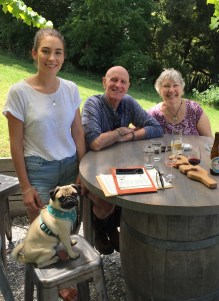
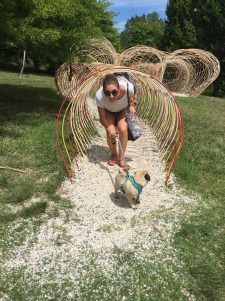
We also had a lovely day with one of our friends who we had met on tour in Morocco. She picked us up with her adorable pug, and we spent the day going North – first to a Farmer’s Market in Matakana for a local fare lunch, then to a winery for a delicious glass of wine, tasting and a beer. The grounds include a beautiful setting for walking along a sculpture trail, somewhat similar to Arte Sella – Art in Nature that we visited near Caldonazzo, Italy. The difference here is there are a few “sound” sculptures, for example a delightful choral piece that felt like they were right there in the woods with us, and, a chorus of frogs near a pond. 

IMG_2304.jpg IMG_2431.jpg

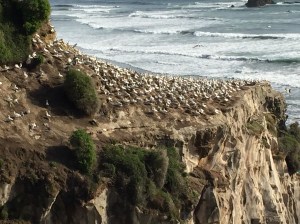
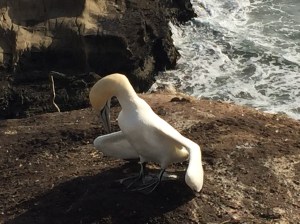
Then our friend took us to Murawai – translates to Water’s end, to see the Gannet colony. While she walked her pug on the “wild west coast beach” as dogs are not allowed near these unique birds, Loren and I hiked up to see them

IMG_2472.jpg IMG_2482.jpg IMG_2477.jpg

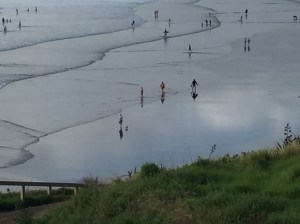
We rejoined on the vast beach where the tide was out. Later on I had a painful lesson – just how much sunscreen and UV sunglasses really are mandatory. I had put sunscreen on my face and the back of my neck, but none on my arms or chest as has become my habit as we have traveled. That evening I was surprised to find that the skin on my arms and chest was burned, though we were only in the sun for a short time and in the late afternoon. The Ozone layer is actually the thinnest over New Zealand, so Loren and I now lather ourselves thoroughly when we will be in the sun.

IMG_2494

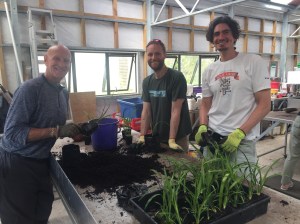
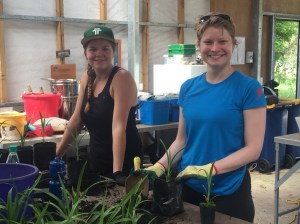
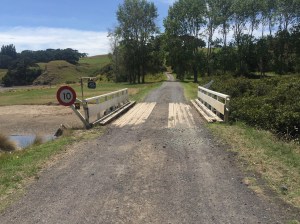
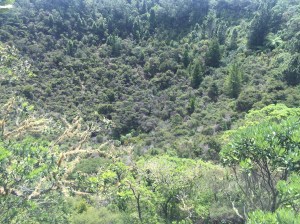
The next day Loren and I took a ferry to Motutapu Island – means Sacred Island. We met our group of volunteers to help with some summertime nursery work for the Motutapu Restoration Trust. Loren and I only put in a half day of transplanting root bound flax seedlings, so that we could walk – excuse me, we have also learned that New Zealanders tramp on tracks. This is like the Nepali and the Americans who respectively trek and hike, on trails. Anyway, we tramped, to the summit of neighboring Rangitoto Island – means Lava Island, to see the crater left by the volcano. Rangitoto and Motutapu Islands are connected merely by a tiny bridge. Rangitoto is quite a new island, as the volcano only erupted 600 years ago. Still the crater has fully filled in with vegetation. 

IMG_2508.jpg IMG_2509.jpg IMG_2510.jpg

Like Nepal, New Zealand has some sub-tropic climate regions. But, unlike most places in the world, New Zealand does not have native critters. To protect their rare bird population, the Kiwi people try hard to eradicate the wild critters that have arrived with foreigners. The native birds used to have a single predator – a very large eagle that sadly is now extinct. The smaller birds’ instinct is to freeze from the eyes of the eagle, but that of course puts them in grave danger from critters. Further, the locals are extremely ecologically protective of their paradise. From immigration enforcing measures on arrival to the country, to shoe washing stations in a variety of places, they aim to protect the endangered Kauri – sounds like the name Cory, tree.

IMG_2520.jpg IMG_2534.jpg

Now, Loren and I have picked up a budget car, a “Commuter Super Saver Toyota Vitz” model in Auckland. Before we left their garage, Loren had to manually manipulate the side mirror as the driver side interior controls did not work. The nice thing for driving on the “proper” side of the road with this scratched up, faded car was that it is an automatic, compared to in Ireland, England and South Africa where the cars were all manual transmission. However, as we entered the Harbour Bridge, said mirror actually fell from its mount! Fortunately, the rental agency has an office just north of the bridge. To our greater fortune, they had only one automatic car available – a shiny, large, Toyota Camry. It was a delight to drive the rest of the way in luxury, at the super saver price…

A word about driving here. New Zealanders are… strict, about their speeds. I am grateful that this second car not only has cruise control but a buzzer reminder should I exceed 100km, to keep within the maximum limit. Here is how it breaks down:

    100km/h, which works out to 62.14 mph is the default on the motorway (highway)
     50km/h, or 31.06 mph is the default for towns and cities
     40km/h, 24.85 mph is for schools at marked times
     30km/h, 18.64 through roadworks, and,
     20km/h, 12.43 for a stopped school bus.

Another word I want to say is about the Maori language. So many places are called by the native names, but learning to pronounce them is a… challenge. We have mastered Whangarei – said Fan-yah-ray, but so many other names – many of which are even spelled similarly, are difficult for westerners and especially us to pick up.

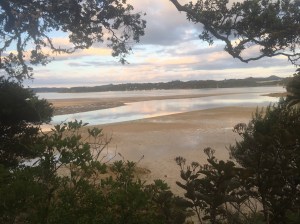
We drove to Paihia – said pie-hee-ah, north of Auckland on the Bay of Islands. One day in Paihia we took a full day tramp, which included – literally, tramping, through rain forested land, as well as taking two ferry crossings as part of the mapped out visitor route.

IMG_2592.jpg IMG_2608.jpg

While in the rain forest, we were thoroughly enchanted by the calls of the Tui bird, but could not manager to snap any photos of them. We also heard lots of cicada chirping alongside an interesting snapping sound. Fortunately the 50% chance of thunderstorms never materialized.

IMG_2611.jpg IMG_2616.jpgIMG_2620.jpg

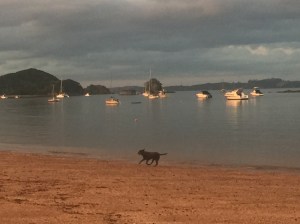
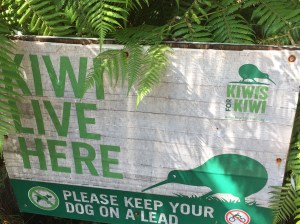
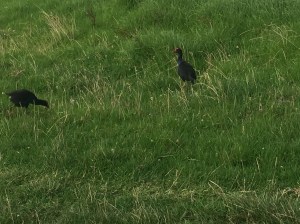
We have also seen many reminders that the Kiwi bird lives in New Zealand. As of yet we have not spotted any… however, they are nocturnal. Still, there are protective warnings to keep dogs on leads as dogs are often a threat to this unique bird. We have seen several Pukeko, or Australasian Swamp Hen. As our friend said, “They are everywhere!”

IMG_2603 IMG_2506.jpg

Next we are heading off by water taxi to tramp to Cape Brett Lighthouse where we will stay overnight. 

Week 199 January 20, 2018

We had three lovely farewell meals at the beginning of this week with some of the friends who we had made in Nepal. One dinner included one friend, and we met two of her delightful Nepali friends, a celebration she had arranged as both she and we were leaving Nepal on the same day. We also had lunch with a traveler who we had met on our first view of Mount Everest from Nagarkot. Both of these women happen to live in New Zealand, and we will see them again when we visit there. The third was a special dinner out with our wonderful hotel owner.

IMG_1887 2

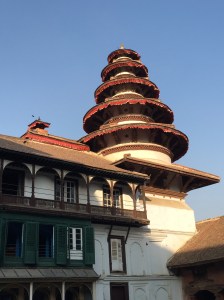
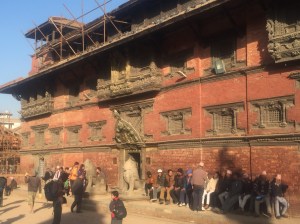
On one of our final days in Nepal we visited Kathmandu’s Durbar Square, which – of all the three former Kingdom palaces of Nepal that we saw, sadly, this one seemed to have been damaged the most severely by the earthquake of 2015.

IMG_1823 IMG_1836 IMG_1832.jpg

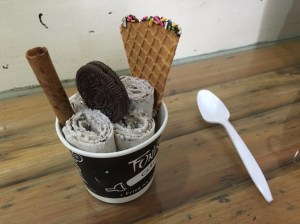
We also treated ourselves to a farewell massage. Then, I walked the 30 minutes to have “fried ice cream” at a place co-owned by the nephew of a friend from California. The dish was as delicious as it was attractive, worth the hour to and fro. Loren passed on the walk – he missed out!

IMG_1882.jpg IMG_1883.jpg

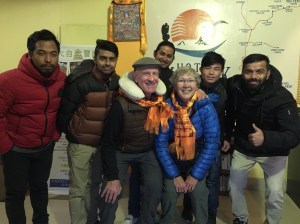
Then, while we were awaiting our car to the airport, our hotel co-owners and their sincere, kind staff gifted us each with a traditional Nepalese scarf. As they put mine on, they said “Saraswati” – the Hindu Goddess who I so admire that her name is part of my email address. Then as they gifted Loren his scarf, they called him “Mahadev,” a manifestation of the Hindu God, Lord Shiva.

IMG_1890.jpg

I am already missing Kathmandu. It was a privilege to stay so long, and it draws on my heartstrings that now we have had to leave our special friends there. I will long treasure my memories from this place. I am reflecting on the several Nepalese words and phrases that we learned, like, soondar for beautiful, that I used so many times on our two treks. Or Tapai lai kosta chha? for How are you? and the usual reply is thik chha for Everything’s OK. When passing the reception desk on the way upstairs to our room each night we said Subha rhate for Good night. What I must say for now to all the wonders of Nepal is: Dhanyabaad and Tapai lai ramro hos – my heartfelt Thank you and Best wishes.

IMG_1852.jpg

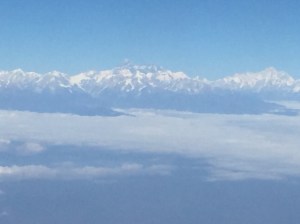
From Kathmandu airport we flew by the Himalaya for our last distant look at the barely perceptible peak of Mount Everest, and, for the next 5 hours to Kuala Lumpur, Malaysia, we witnessed day slip into night. This leg entailed a 2 hour time change…

IMG_1909.jpg IMG_1934.jpg IMG_1940.jpg

After a 2 hour layover, we flew another 8 hours overnight to Australia’s Gold Coast airport. On the way I was tickled to see the Southern Cross constellation from my window, but my camera could not capture it. Soon afterwards I looked down on a magnificent lightning storm, that my camera could catch, but barely did justice to what I saw. Imagine two more nearby spots of repeated similarly bright intermittent though frequent flashes… incredible. We had another 2 hour time difference with a one and a half hour layover. Here we were made to de-plane solely for a rigorous security check just to return to our same seats on the same plane. Maybe it was because the flight crew was changing, but felt unnecessary, even bothersome. Actually, this required us to put our feet on Australian soil, making this our 7th of 7 continents to spend a bit of time on!  

IMG_2101.jpg IMG_2125.jpg

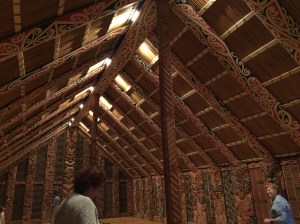
Then we flew the 3 hours to Auckland, said Awkland, actually, and had our first view of the terrain of New Zealand. With another 3 hour time difference on arriving, it put us ahead of Nepal by 7 hours. So, we have been a little bit jet lagged this week. Here we have learned to say Kia ora – pronounced key-ora, for Hello! in Maori – said mah-awree, the native tongue. We are learning too how to speak English – New Zealand style. For example, what would sound like “Ken ewe meek thee bead?” would translate to “Can you make the bed?” And, again I recognized that the stars on the flag represent the Southern Cross constellation, thanks to a friend originally from Australia who we met in Egypt. 
IMG_2132.jpg

In planning for our time in New Zealand, Loren had wanted to ride “The Magic Bus” that he had heard about when he traveled those 18 months by bicycle some 40 years ago. However as we looked into it – which company goes by a new name now, it seems to cater to the partying-20-something generation, so that pursuit has come off of our wish list. Also, we had read that it is best to visit the South Island in February and the North Island in March. So much for that advice – we are on the North Island now and will not reach the South Island until mid-March. At least we observed the warning to avoid December for the seasonally higher costs, but, we are here for the February to March cyclone season… Hmmm, that sounded frightening. So, my concern made me curious.

What I found is that “cyclone” is the name given to storms that arise in the South Pacific and Indian Oceans; “typhoon” is given to storms that start in the North Pacific Ocean, while, “hurricane,” is what is used for the same type of storm that forms in the Atlantic Ocean. That helped put such fearsome phenomenon in perspective. Further, I was interested to learn that “monsoon” means a seasonal prevailing wind in the regions of South and South East Asia, northern Australia and Malaysia, as well as in parts of the western hemisphere. A monsoon is not a single storm, but a shift in wind direction seasonally, that blows from the south-west between May and September and brings rain – called the wet monsoon, or, from the north-east between October and April – called the dry monsoon. All words that I had heard over my lifetime but had not understood.

In Auckland, we managed to take a full day tour that gave us a little insight into the Maori cultural heritage, 

IMG_2161.jpg IMG_2184.jpg

as well as introducing us to some of Auckland’s geographical highlights.

IMG_2201.jpg IMG_2225.jpg

We have also enjoyed a lunch date with one of the two women who we had met in Nepal and had a farewell lunch with. We also had another lunch date with a young woman who we had met on our overland trip in southeast Africa two years ago. Tomorrow we look forward to an outing with one more young woman who we had met on our tour in Morocco a year and a half ago. And, we hope to see our one other friend who we met in Nepal next month, when we are on the South Island where she lives. 

IMG_2283.jpg

Our AirBnB studio apartment is a block from the Auckland Sky Tower. As the week wore on it became overcast and more humid, even quite stormy. This rainy weather makes our hot yoga a little harder, but, we are thoroughly appreciating it. I was invited to teach a couple of the classes too, which I happily accepted!

IMG_2142.JPG

Week 198 January 13, 2018

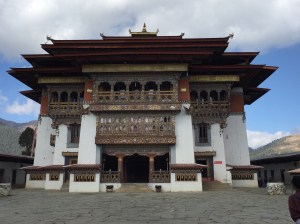
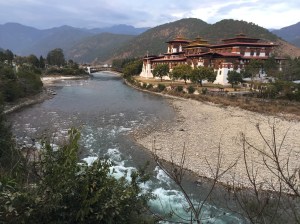
Kuzu zangpo la! Hello! in Dzongkha, the language of Bhutan. The beginning of this week found us still in the “Land of the Thunder Dragon,” as it is known for that weather phenomenon’s regularity during the wet monsoon. Loren and I learned so much from our young Guide during our short visit – about the culture, geography and history of the country, about Buddhism and local wildlife, and, we benefitted from and perhaps even contributed to GNH – their Gross National Happiness initiative. To begin with, Bhutan is home to more than 2,500 monasteries. We visited only a few of them in the four of Bhutan’s twenty districts that we visited: Paro, Thimphu, Punakha and Wangdue. Many of the monasteries are located in former dzongs – fortresses, originally used for defense by the army, that today house both administrative offices and temples.

IMG_1444.jpg

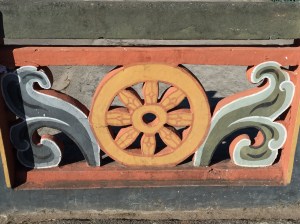
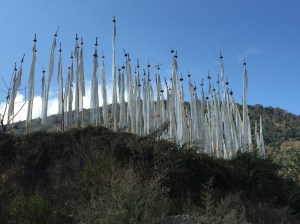
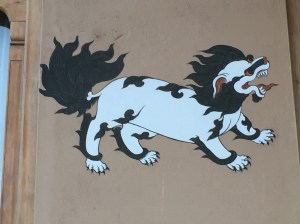
We learned that the Bhutanese people are steeped in cultural traditions, one where buildings and public sites are often decorated with beautiful pictures or crafted symbols of The Eight Lucky Signs, which include for example the Buddhist symbol of the Wheel of Dharma. Another is to erect fields of white prayer banners to honor the souls of departed loved ones. Similarly, many of the houses are protected with painted designs of the four strongest guardians: ferocious Tigers, imaginary Snow Lions, an imaginary Garuda bird, and, the formidable Dragon. Loren and I learned how the three most revered figures in Bhutan include Buddha, Guru Rinpoche who is originally from modern-day Pakistan and who brought Buddhism to Bhutan in the 7th century, and, Zhabdrung, affectionately known as “Beard Man,” who united the country in the 17th century.

IMG_1220.jpg IMG_1283.jpg IMG_1661.jpg

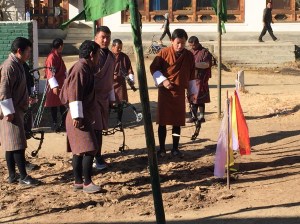
Another cultural belief in Punakha, where two rivers meet, is that the faster moving – more aggressive – Phochu, is labeled male, and the deeper, wider, slower moving Mochu, is considered female. Past their joining point, they are called the Combined Male-Female river. All over the country there is a penchant for the ancient craft of archery, but now played with high tech equipment in the larger cities. A friend suggested that we must see a tournament, which our Guide helped us to do. In seeing the “two football fields” length of the target being hit, we watched the opposing team members enact the tradition of calmly singing and dancing briefly, to honor the achievement. 

IMG_1480.jpg IMG_1232.jpg

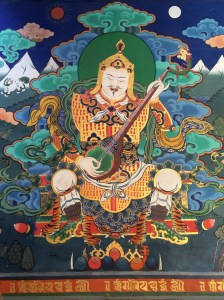
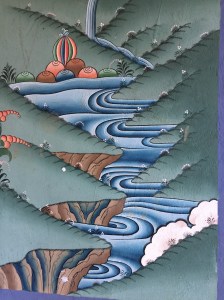
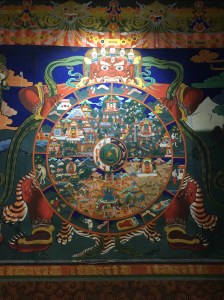
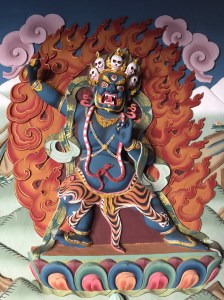
In many of the temples we were taught about the pleasant- to fearsome-faces of heroes and guardian gods. For example we learned those of the Directions, where North holds the lucky sign of victory, East is portrayed a heavenly musician, South bears a sword, and West lifts up a stupa. On temple walls and even painted on trucks, we found the Norbu image, representing imaginary jewels to be sought from chhu, or water. Our guide also pointed out images of the Gods of Compassion, Wisdom, and Power, of the scenes of a very old man to be prayed to for Longevity, and, of the Wheel of Life, a 6 realm mandala held by the Lord of Death to represent certain aspects of life to avoid and to strive for, that we encountered in each of the various monasteries.

IMG_1643.jpg IMG_1449.JPG IMG_1647.jpg

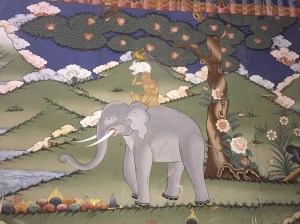
One pictorial representation we often encountered too is of the parable taught by Buddha of the Elephant, Monkey, Hare, Bird and a fruit tree. The one version explains how the four animals pleasantly worked out who was eldest to teach respect for elders, another is on learning to work together. Loren and I also had the chance to have a Monk give us an astrological reading, where he affirmed aspects of our individual lives, and pronounced the strength and stability of our relationship.

IMG_1461.jpg

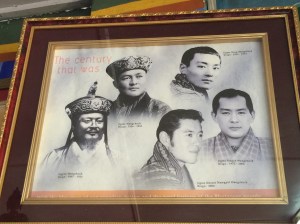
We also learned of the more than 110 years of monarchy in Bhutan, and of how the third of the five Kings is considered the Father of Modern Bhutan. He died at just 46 years of age in 1972, when the 4th King-to-be was only 17 years old. He was their youngest King crowned at age 19. It was prophesied that he would have 4 wives, and it was his second of the four who gave birth to the next heir to the throne. When the 4th King was in his fifties in 2006 he turned the throne over to the 5th and current King, who is now 37 and has a son. We saw numerous venues proudly display photos and images of the lineage of the monarchy, and especially of the current king and his wife. One fellow American who we met over dinner suggested that a benevolent King is the best form of government.

IMG_1453.jpg

In our travel further east in the country, we saw firsthand how every winter the Bhutanese must reconstruct their narrow cliffside roads, because every summer harsh monsoon rains cause destructive landslides and rockslides in the Himalayan mountains. Our driver was adept at navigating the boulders that blocked many parts of the unpaved roads, and around the heavy equipment working to create new pavement. 

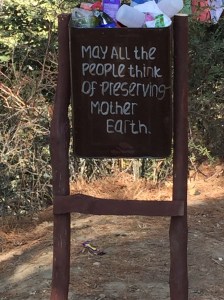
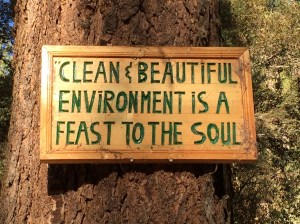
What we also found is that Bhutan is socially and ecologically minded. There is much gender equality visible and citizens receive free healthcare. The #1 industry is the export of hydroelectricity, with tourism and export of agricultural produce #2 and #3 respectively. In 2008 the country voted in their constitution a mandate to retain 60% of their land as forested. They have 72% forestation currently. We also noticed much clever signage along hiking trails, reminders for keeping the nature free of trash,

IMG_1680 IMG_1677

and, along the more traveled highways between the large cities of Thimpu and Paro, such encouraging and inspiring reminders as:

     Alert today: Alive tomorrow…
     Drive slower: Live longer… 

     Let’s go green to get: Our globe clean.

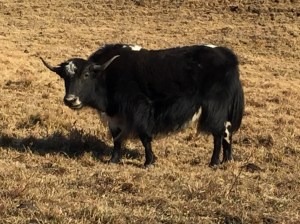
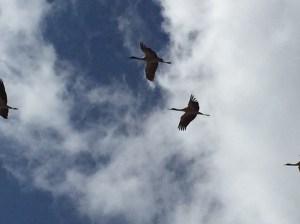
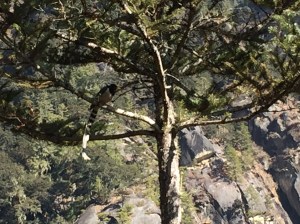
Perhaps my favorite part of the week was seeing wildlife. While hiking we saw monkeys in trees and Samar deer near a monastery. While driving we came across several yak in a remote meadow. One morning we saw the national bird, the Raven, then we visited the Black-Necked Crane Visitor Center to learn about these unique “Heavenly Birds.” Then we went hiking to see them in the Phobjikha Valley where lucky for us they are overwintering from their home in Tibet. Near the “Combined Male-Female” river, we saw Ruddy Shelduck who reminded me of Egyptian Geese that we had seen in southeast Africa. And, while hiking to Tiger’s Nest, we were treated to a flock of scavenging Yellow Billed Blue Magpie. We were not so fortunate to see the endangered White-Belly Heron nor the rare national animal, the Takin… two reasons to someday return to Bhutan.

IMG_1314.jpg IMG_1420.jpgIMG_1556.jpg IMG_1697.jpg

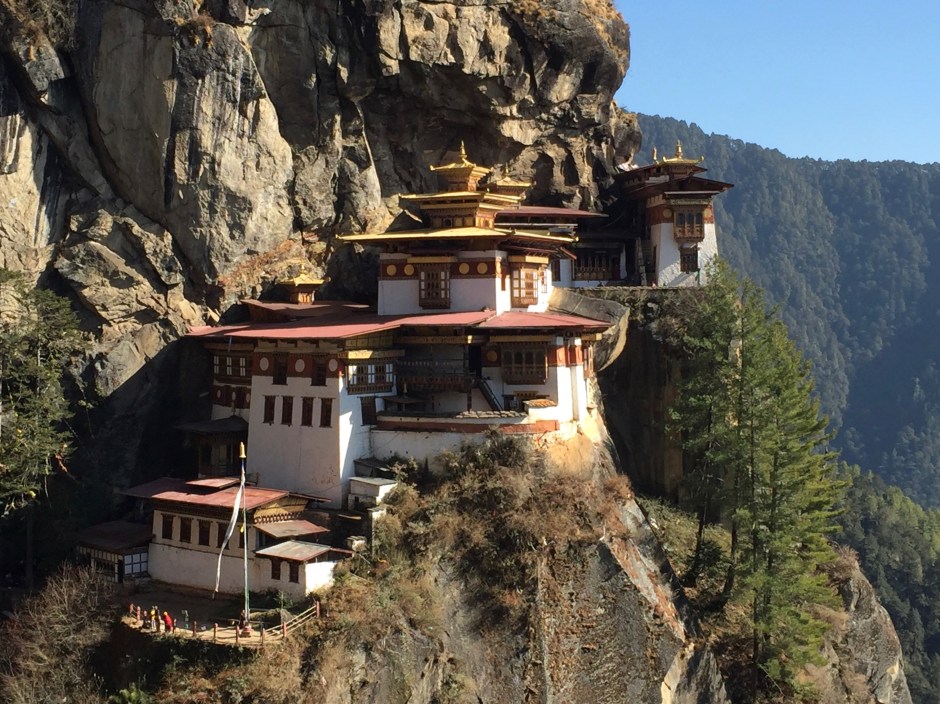
We ended our tour with a hike up to Taktsang, more famously known as Tiger’s Nest, and visually familiar to me from cliffside temple photography. It clings to rocky outcroppings far above Paro’s forested valley. While hiking I repeated the Bhutanese word that sounds phonetically like go-leh-beh, which said twice means slowly, slowly, which I needed to go on the steep uphill stretches. The temple was originally built in the late 1600’s, a tribute to Guru who meditated for extended time here. He is fabled to have subdued a hostile tiger demon by transforming into a formidable persona, riding his consort in the form of a tigress to the cave dwelling where the demon lived. Previously I have found fierce images such as of Guru unpleasant to behold. Now, I so appreciate what these dangerous looking figures represent – protectors of the people from destructive forces of evil.

IMG_1219.jpg

Thank you for following along again on our Journey! Back in our cheerful Room 405 in Kathmandu, we send you a last Bhutanese sentiment, for now:

Tashi delek (said tah-shee de-lay), meaning Best wishes!

IMG_1788.jpg

Week 197 January 6, 2018

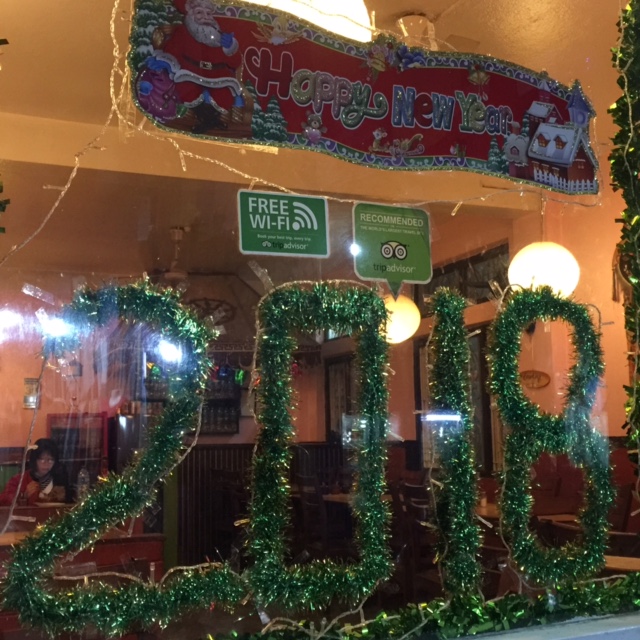
Happy 2018! And, Happy Little Christmas, January 6! To commemorate this new year, I want to share words from around the worldfor Cheers! Well, words or phrases that mean Cheers, Happy New Year, or To Your Health, and only some from some of the parts of the world where Loren and I have visited, or words that we have learned or discovered  from other travelers, and, mostly in my own form of phonetic spelling:

Agyshegette, Doormoi, Fe Sehetak, Geevehlee, Goang Shi Fah Tzai, Gong Hay Fat Choy, Na Zdrowie, Narok, Nastarovia, Nossa, Nostrovi, Prost, Salute, Sante, Sawl E Neu Mubabrak, Slainte, Stiniyamas… however you may say it, we send our Best Wishes!

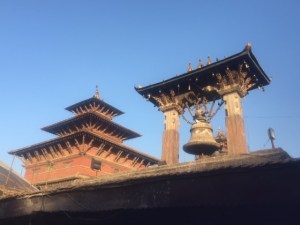
We spent New Year’s Eve in Patan Durbar Square, the second historic Palace that we have seen of what was once Nepal’s three kingdoms. The first one we saw in Bhaktapur last week, and we hope to visit the third in Kathmandu before we leave Nepal.  It is sad how, just as was true in Bhaktapur, Patan’s Durbar Square suffered a great amount of damage during the 2015 earthquake. The reconstruction is painstaking and ongoing. 

IMG_0711.jpg IMG_0743.JPG IMG_0746

We also celebrated a lovely New Year’s Eve! We visited a new friend and her husband who live in Patan. They are originally from the Netherlands, and we had met her with another “Dutchie” on our Poonhill trek. They served us a delicious dinner, and with lively conversations the evening simply slipped by! When Loren and I returned to our Thamel neighborhood by taxi it was just before midnight, and the streets were as “crazy” as our hotel owner had warned. We eventually and safely squeezed and pushed our way through the streets full of throngs of revelers… On New Year’s day Loren and I enjoyed another peaceful and leisurely dinner from the special holiday menu at the downstairs restaurant of our hotel, served by one of the always friendly and helpful waitstaff.

IMG_7831.jpg IMG_0752 2 IMG_0754.jpg

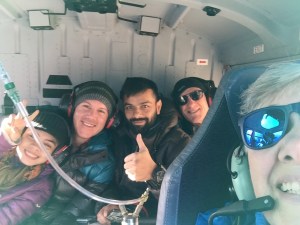
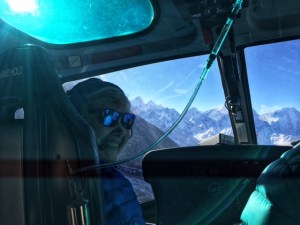
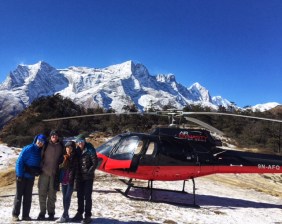
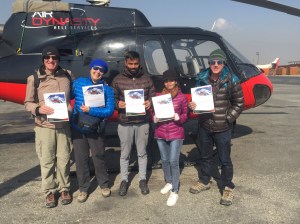
One travel book claimed that treks are the most popular activity in Nepal because of the “gasp-worthy views of the Himalayas.” Gasp-worthy is true to our experiences, and now we have had two more opportunities to gasp. Loren had told me while we were in Nargakot on our second trek, that with our hotel owner’s help his Christmas gift to me would be a helicopter ride to see Mount Everest up close. Wow! However, it did not seem possible as other than our generous hotel owner who would join us, there were no other people interested to share the cost. We were considering other options, maybe a shorter flight, so kept putting it off, until… This week, another couple who were also interested showed up, and voila! We took the “heli” ride on short notice.

IMG_0779.JPG IMG_0849.jpg IMG_1105

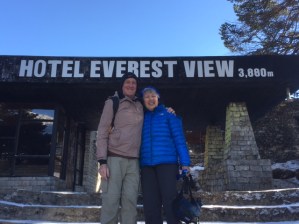
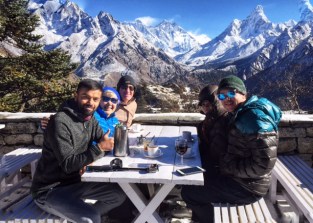
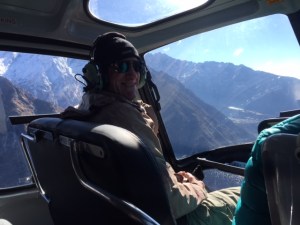
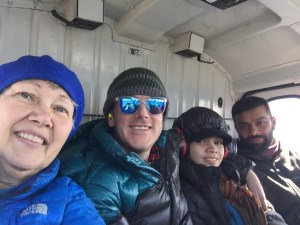
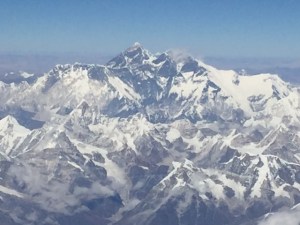
It was a phenomenal time! Neither Loren nor I had ridden in a helicopter before, and, to see Everest this way was priceless. The pilot showed us that his thermometer read -40C as we neared the summit. Our trip included breakfast on the outdoor patio at nearby Hotel Everest View. There it is – the tallest mountain on the planet above sea level just above Loren in the photo, with the wind stirred clouds blowing off to her right. The pilot landed twice, so both Loren and I had an opportunity to sit in the front seat.

IMG_0954.JPG IMG_1096.JPG IMG_1091

Not only did we share a most exciting experience together, we so enjoyed this other couple that we also had dinner together that evening. Loren and I have been so privileged to meet some very special people on our Journey. It is always wonderful when the connection is as strong as some have turned out to be. 

IMG_1003.JPG IMG_1010.jpg IMG_1062.jpg

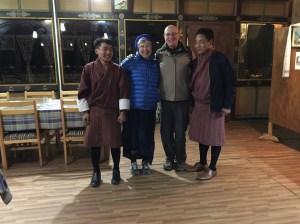
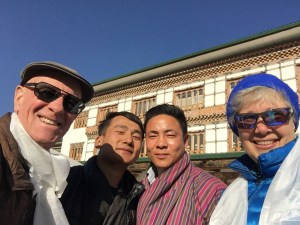
Loren had also insisted that since we are so close, we must visit Bhutan before we leave this part of the world which we had arranged. Our flight from Kathmandu to Paro the next day afforded us an opportunity to see Mount Everest from yet another vantage point, and we are most grateful for this additional view via another mode of travel. Now, today is our second of seven days of visiting in Bhutan. We were welcomed by our friendly guide and driver with gifts of traditional white scarves. They are wearing the traditional knee high gho outfits for men. Women wear traditional full length kira skirts. 

IMG_1137.JPG IMG_1157.jpg

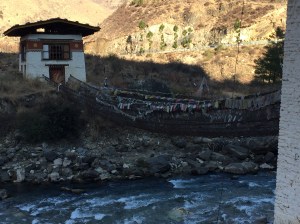
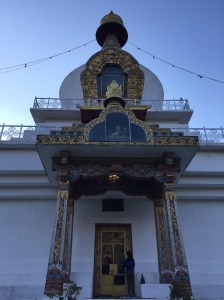
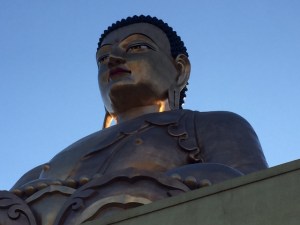
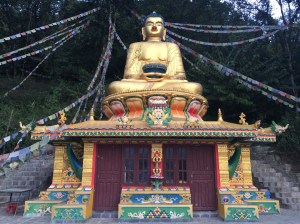
The Kingdom of Bhutan requires tourists to be guided, not to travel on their own. It is a landlocked country of 700,000 people in the Himalaya, bordered to the north by Tibet autonomous region of China, and, otherwise, surrounded by India. It is a country where 87% of the population practice Buddhism. We have already driven from Paro where the airport is, to the capital city, Thimpu, which has a population of 100,000. So far we have seen a 14th century iron chain link footbridge, and an impressive Memorial Chorten or Stupa; we have hiked up to two different monasteries – one where we had our recently purchased prayer flags blessed, and, seen the enormous, newly erected statue of Buddha.

IMG_1159.jpg IMG_1170 IMG_1198.JPG

It is much colder in Bhutan than in Kathmandu – as we were forewarned, and, this afternoon a chill wind kicked up and has increased in intensity as the day has worn on. We are so very grateful for the roof over our heads and for the heater in our hotel room.

Week 196 December 30, 2017

This week we wish our family and friends who celebrate, a very Healthy and Happy New Year! We learned here in Nepal that our 2017 is actually their year 2074…

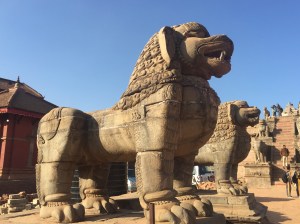
Loren and I started our week in Bhaktapur, about an hour away from Kathmandu by car. We walked around Durbar Square, appreciating the incredibly intricate detailed hand carvings on the wood at so many of the temples, and, mourning the need for ongoing rebuilding from the destruction that occurred in the 2015 earthquake. For example, stairs to some of the temples remain, but the temples are completely gone. 

IMG_0352.jpg IMG_0365.jpg IMG_0367.jpg

At dinner in our hotel’s restaurant we tasted our first Juju Dhau, a traditional sweetened yogurt that is famous in Bhaktapur. I should also mention that our favorite dishes in Nepal have been, for Loren, vegetable Thuppa which is a noodle soup, and, for me, vegetable Momo, which are dumplings, or, Loren likes to call them Nepali ravioli. We have also both enjoyed vegetable Pakouda, a deep fried delight, and Papad Masala which is papadam with veggies peanuts and a light sauce sprinkled on top, a bit like nachos. I also appreciate vegetable Dal Bhat – rice with lentils, and sometimes served with a piece of papadam, pickle sauce, Nepali spinach, and curried vegetables. Over dinner on this particular night, we met an interesting Italian man, and enjoyed conversations with him at dinner and over breakfast. This first photo is a morning view from our hotel rooftop.

IMG_0412.jpg IMG_0418.jpg IMG_0426.jpg

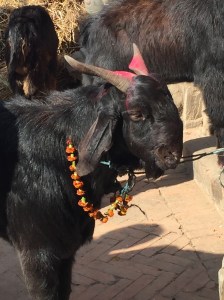
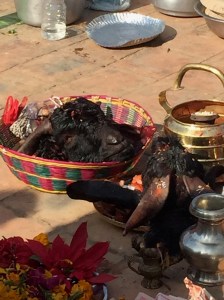
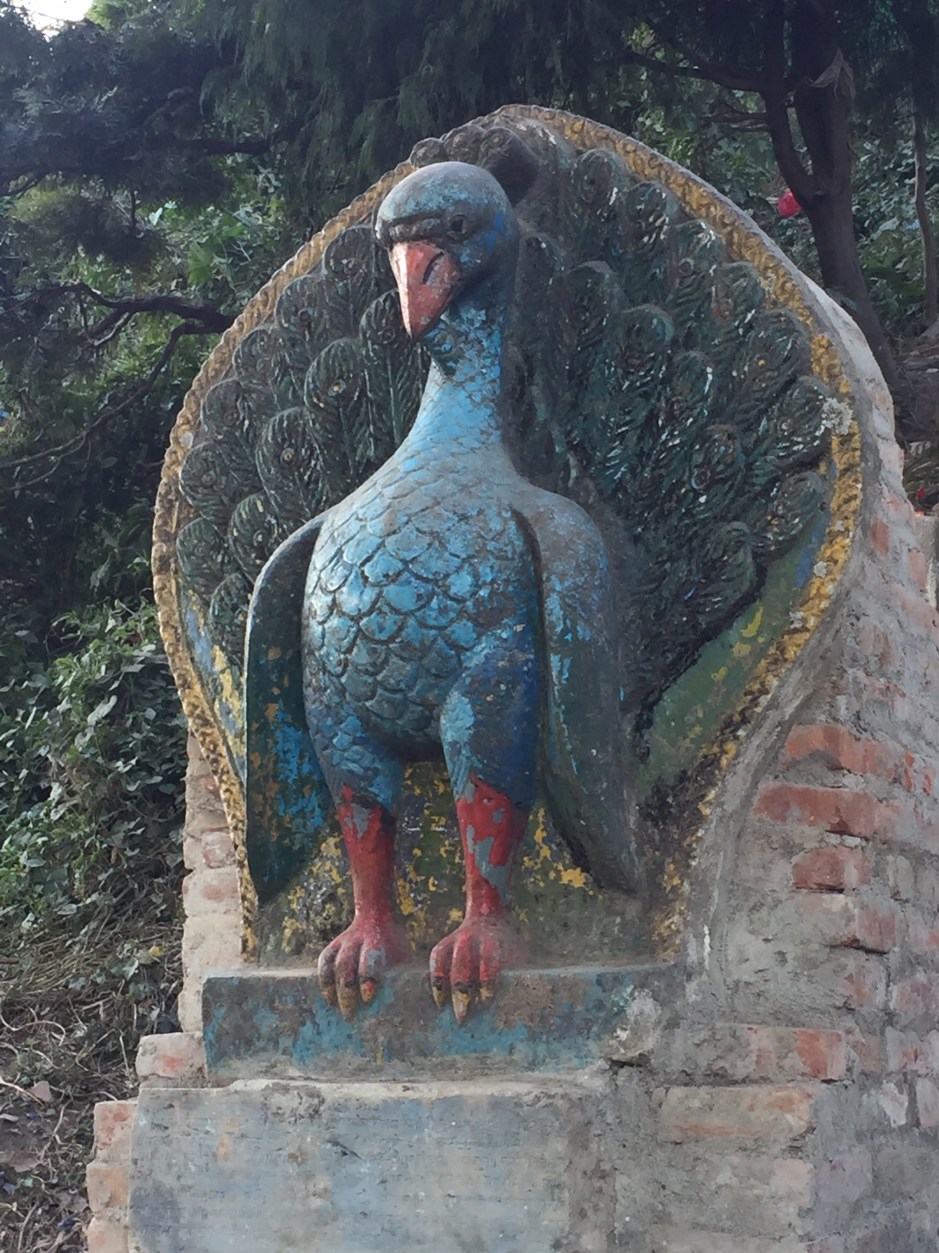
With our newest friend from Lombardia, we visited the “Peacock window,” walked to the river where cremations are done, visited the museum, and, saw the “55 Window Royal Palace.” There were none happening this day, however, we did witness a ceremonial – what we surmise was an offering – of a cock, that included methodical decorating of a shrine before and after the beheading. We also saw the before and after – again we assume to be an offering – of two goats, which was accompanied afterwards by a lengthy musical tribute by about a dozen men sitting in a circle playing horns. We bade our friend farewell after lunch together, then Loren and I returned to Kathmandu by taxi.

IMG_0428.jpg IMG_0437.jpg IMG_0457.jpg

This week included Christmas. The Nepali were honoring their tourists, with lights and special offers. We first enjoyed celebrating with FaceTime visits with Loren’s Mom and Sister, and, with my Brother, Sister-in-law and one of our Nieces.

IMG_0497.jpg

We then had a light dinner on Christmas Eve in the restaurant downstairs from our hotel, and returned there on Christmas at 2pm for a most leisurely dinner, which included sparkling wine, appetizer, main course, desert, cognac and coffee. We thoroughly enjoyed the peaceful atmosphere of the quiet restaurant… for nearly 6 hours!

IMG_0498.jpg IMG_0501.jpg IMG_0519.jpg

Santa brought us each a massage and we watched a video of Little Buddha which our Italian friend who we met in Bhaktapur had suggested we see. 

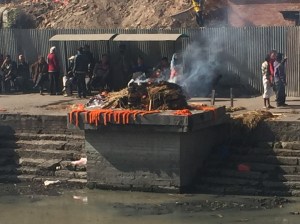
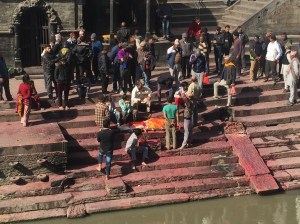
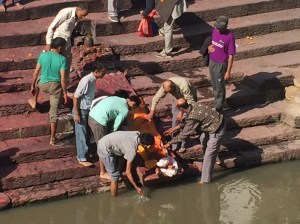
One other memorable experience for us this week was in visiting Pashupatinath with our New Zealand friend from our hotel. We went by taxi to this, Nepal’s holiest Hindu site that is devoted to Shiva. It is located on the banks of the Bagmati River. One writeup suggests that it is “always abuzz with pilgrims and sadhus (Hindu holy men), a place of somber worship, as it is also the city’s most important cremation ground.” It too is a World Heritage site. Here we respectfully witnessed some cremations, and, we saw the body of one deceased elderly man being prepared, which included a ritualistic foot bath. 

IMG_0532.jpg IMG_0587.jpg IMG_0592.jpg IMG_0613.jpg

I also want to mention how impressed we have been with the hardworking people we have met, including many who are young adults – in our hotel, the restaurants we have frequented, and elsewhere, and always with a greeting, smile and generosity of spirit. It is so touching and endearing! At the same time we have been dismayed to observe some abject illness, disease – some seeming worthy of medical care or hospitalization, and extreme poverty, that we have come across in parts of Nepal. Certain memories of Lumbini, Bhaktapur, and Pashupatinath stand out as examples. How I wish the turning of the western year could bring a turning of fortune for all these people! We are consoled with the notion that at the very least our tourist dollars are helping in some small way. 

Week 195 December 23, 2017

This week we wish to those who celebrate, a very Merry Christmas! This will be Loren’s and my second Christmas spent away from home on our Journey…

We were finishing our second trek in Nepal at the beginning of this week. At breakfast in our hotel in Dhulikhel, a bird came to the nearby balcony and serenaded us for quite a while.  

IMG_0130.jpg

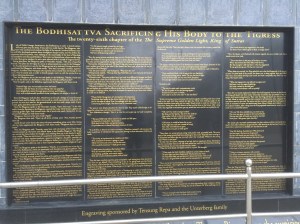
After breakfast we hiked to Namo Buddha for our last overnight of the trek, and stayed  at the monastery called Thrangu Tashi Yangtse. This is much bigger than the other monastery where we had stayed in Lumbini. Where that one had just 3 adult and 3 youth monks, this one had 200 adult and 150 youth. It was built as a tribute to the “place of Great Compassion,” the site where Buddha, in a former life, had selflessly given his body to a starving tigress to feed her cubs.

IMG_0155.jpg IMG_0181.jpg IMG_0188.jpg

The meditations at Namo Buddha were more elaborate in that they included a larger number of percussion instruments, and some parading of sacred objects during the prayers. The meals too by contrast were very simple, methodically dished out by the youth from huge containers – as we sat seat by seat, row by row, compared to the generous, more family style meals in Lumbini. 

IMG_0192.jpg IMG_0205.jpg IMG_0258.jpg

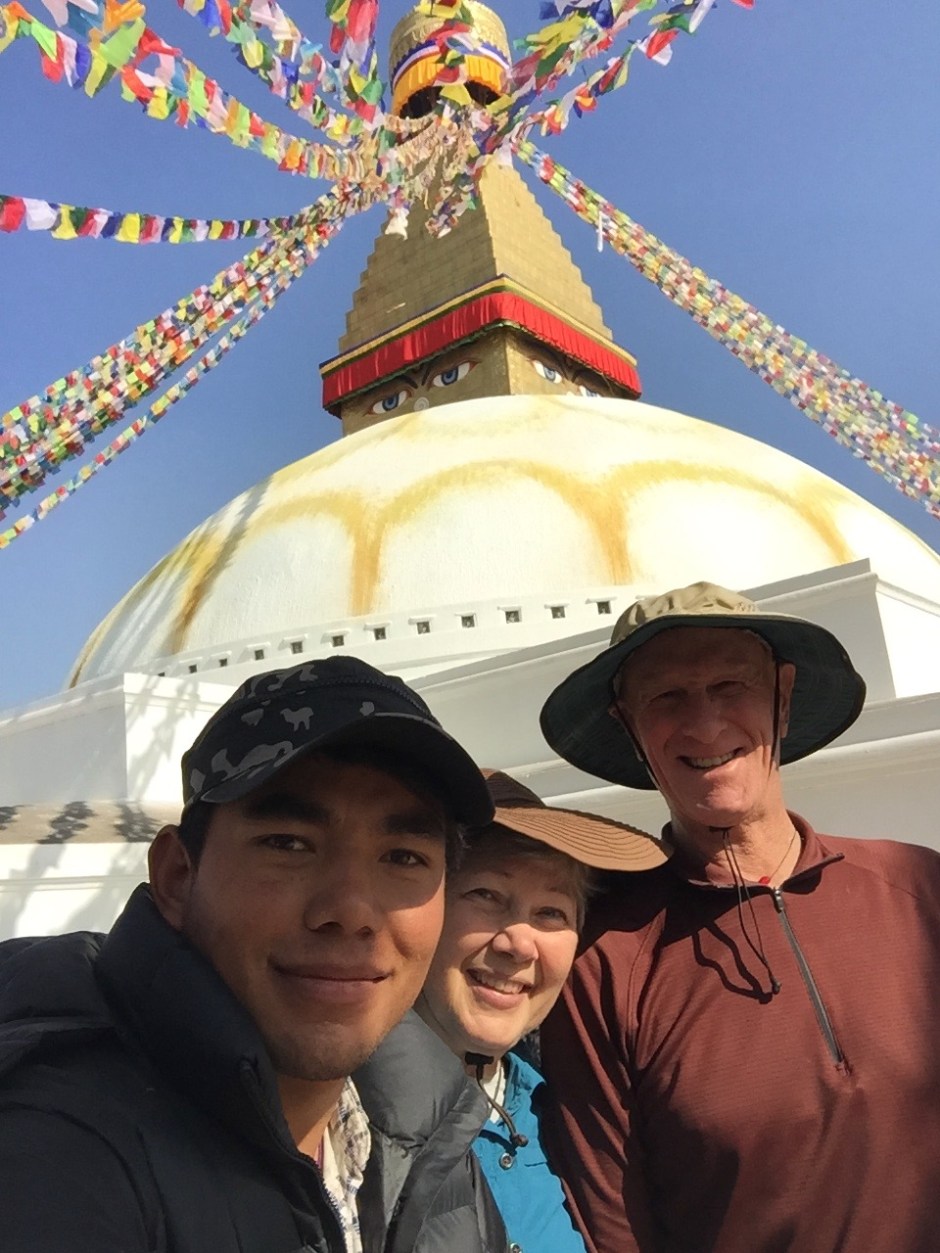
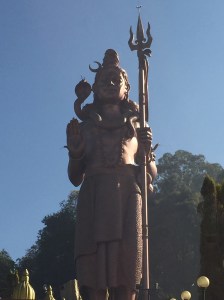
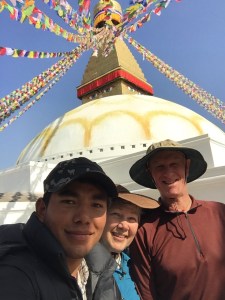
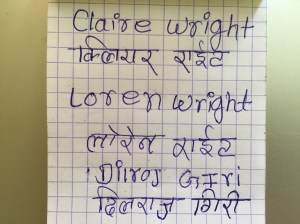
From Namo Buddha, our return drive included a stop in Sanga to see an enormous status to Lord Shiva, The Destroyer, one of the three most prominent Gods of Hinduism. We had originally intended to hike here and spend the night, but we opted to continue on back to Kathmandu by car from Namo Buddha instead, as we had taken an extra night earlier in the week, and, it would have been “hiking” strictly on paved city streets. We also stopped at Boudhanath Stupa in the eastern outskirts of Kathmandu. This is a UNESCO World Heritage Site and considered the holiest Buddhist temple outside Tibet. With Dil, we enjoyed our lunch at a rooftop restaurant with great views of the stupa. I asked him if he would please write our names in Nepali script, which he seemed happy to do, writing first the characters, then adding the line at the end over each word.

IMG_0264.jpg IMG_0319.jpg IMG_0341.jpg

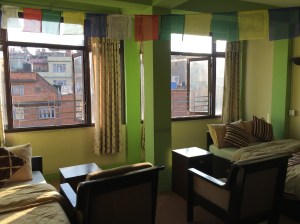
Back in Kathmandu, we said goodbye to Dil, and settled back into our cheerful hotel room, which Loren has decorated with two strings of prayer flags. We have enjoyed two fun dinners out as well. One with the young woman who we had met in Nargakot, and who was preparing to leave for her trek to Everest Base Camp. The other with our friend who is staying at our same hotel. At her suggestion, today we are on our way overnight to Bhaktapur – about an hour from Kathmandu to see Durbar Square there. 

IMG_0338.jpg IMG_0344.jpgIMG_0348.jpg


Week 194 December 16, 2017

We wish our Dear Family and Friends a Happy Hanukkah, to all who celebrate!

This week we met some fellow travelers at our hotel. With one, we made a date for a night out to dinner together. Originally from Chile, then Easter Island, she now lives in New Zealand. She is not leaving Kathmandu until the same day that we are, so we will be able to spend more time with her. We also met a couple of American filmmakers who had sold their home in Florida. Before they left for the airport we enjoyed a couple of conversations, one about the film they just made about building a volunteer Earthship in Nepal. Loren and I had stayed at an Earthship in Taos, New Mexico last year, where the architectural design was developed. We learned from this couple that PT stands for Perpetual Traveler. Loren and I know that we are not PTs, we are simply on extended travels, for now.

We also had an enchanting afternoon and evening at the Garden of Dreams. This was once a palatial garden that had fallen into disrepair, and has been reopened now for some few years. It affords innumerable nooks with bench seating, where it seemed that nearly as many couples sat close, enjoying the quiet solitude. We spotted our first Christmas tree at the cafe here and splurged on a light meal. I noticed that some dishes on the menu included the GOD acronym in the name. At dusk, flocks and flocks of crows cawed and cawed as they flew nearby, as they do each  morning near our hotel, but this evening being outside reminded us both of the Alfred Hitchcock thriller, The Birds. By staying to eat, we were then treated to the attractive night lighting of the grounds. This park offers a welcome respite from the chaotic city streets just outside the Garden walls.

IMG_9718.jpg IMG_9729.jpg IMG_9738.jpg IMG_9744.jpg

The rest of the week found us with Dil again. This time he was guiding us on a trek in the Kathmandu Valley. On the way to our starting point by car, we stopped at Gokarna Mahadev Temple. I had read that this is “a visual A-Z of Hindu iconography.” The only image I could identify with any certainty was Brahma, from his four heads. Brahma is the supreme Hindu diety, called the Creator. Dil helped me identify a few others that were less known to me.

IMG_9806.jpg IMG_9807.jpg

We then began our trek in the town of Sundarijal, along the southern edge of the Shivapuri-Nagarjun National Park. We trekked north, on trails in lush forested “hills” – which to us are more massive than that name implies. True to the write up I had read, we passed through several traditional villages, and saw many, many small farms, each home to a buffalo or two, some goats – more so than sheep, and usually several chickens.

IMG_9827 IMG_9836.jpg

We had our first views of the snow-capped Langtang range of Himalayan peaks as we approached Chisapani at the north end of Shivapuri Park. Also spelled Chisaapaani, it means cold water. This tiny village where we spent our first night had been all but eliminated in the 2015 earthquake. We learned from our guesthouse family that sadly, “six people were killed here, and everyone was injured.” The owners of the most badly damaged buildings have chosen not to rebuild and since relocated to Kathmandu. Such a tragic event for such an idyllic setting… 

IMG_9847.jpg IMG_9875.jpg IMG_9883.jpg

We continued on after breakfast with our next night’s ambitious – for us – destination of Nargakot. The  downward slope to Jhule village was incredibly steep, demanding that we take it extra slow, so we stopped for overnight accommodations with a lovely Nepalese family just outside Jhule instead. 

IMG_9966.jpg

The panorama of surrounding mountains on our Kathmandu Valley trek were supposed to include Mount Everest, but, for our two whole days out, the easterly direction toward Everest had been completely shrouded in haze. We did have wonderful views of the Ganesh and Langtang peaks though…

IMG_9912.jpg IMG_9979.jpg IMG_9971.jpg

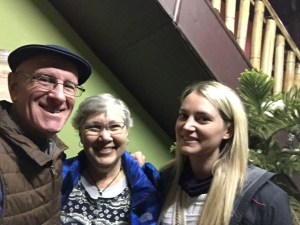
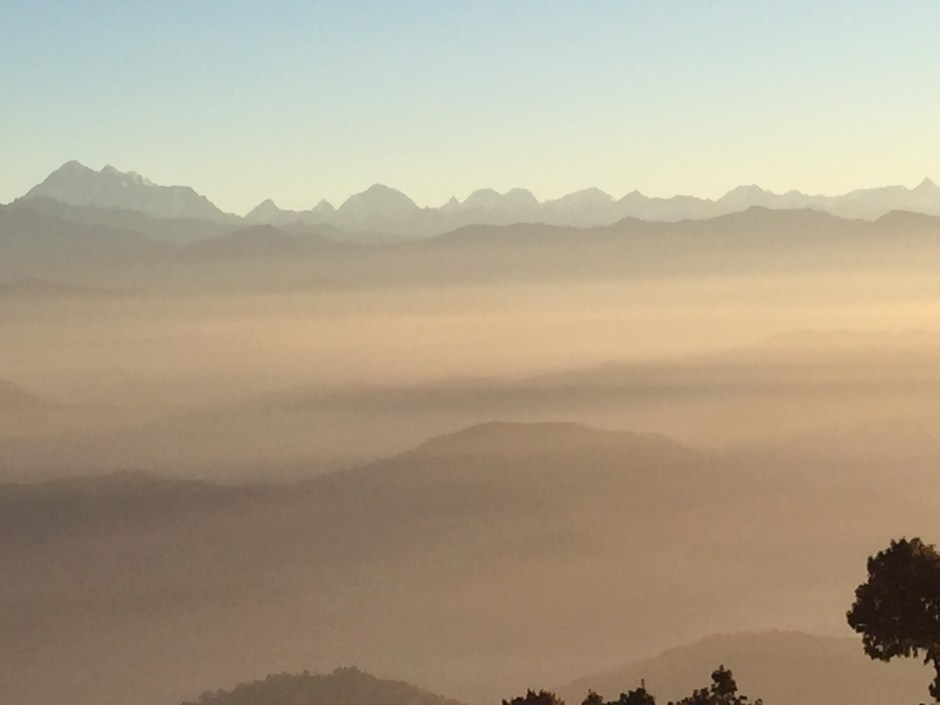
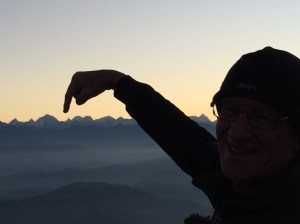
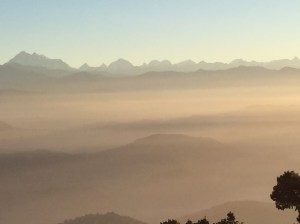
As we set out again in the morning for Nargakot, I spoke out loud my prayer for the haze to clear off. And with each string of prayer flags that I saw as we walked, I silently said my plea. When we arrived in Nargakot, not only was it was completely clear, it remained so until sunset, and we were able to pick Everest out in the distance from a detailed map provided by our hotel. In the photo below, she is barely visible in the background to the right of the highest peak in the center. There were some friendly people at our Nargakot accommodation, and we especially enjoyed talking in Italian with a couple from the Lombardia region of Italy, and, a young woman from New Zealand. Another young couple with their year old son, from Canada, will spend the year working in Kathmandu.

IMG_9989.jpg

Nepal is home to 8 – more than half – of the world’s 14 highest peaks over 8,000 meters. We had already seen Dhaulagiri living up to its name, “The Shining White Mountain,” and the Annapurna Massif from our first trek to Poon Hill with Dil on another beautiful, clear morning. We had seen Manaslu, ‘The Mountain of Spirits,” the Annapurna Massif, and Dhaulagiri, from a distance when Loren and I had hiked up to Sarangkot from Pokhara too. But Mount Everest, known in Nepali as Sagarmatha, is the tallest in the world at 29,035 feet or 8,850 meters from sea level, striding the border with Tibet. It is also known as Chomolungma or Qomolangma in Tibet, and Zhumulangma Feng or Shengmu Feng in China. Most westerners refer to her by the British surveyor’s name.

We were so lucky that the skies remained clear on through to sunrise to see her again, with an even better clarity to our view. Our Italian friends were up on the rooftop early too, to share in the excitement. I asked Loren to help point out Mount Everest in the distance so that there is no mistaking now just which peak is hers.

IMG_0017.jpg IMG_0027.jpg

As we continued our trek and viewed the surrounding Himalayan vistas, I came up with a way to help me remember the names of the peaks from west to east. It started out as just mangle:

     “DAM5-Mach-ManGLE (SCZ),” which stands for Dhaulagiri, the Annapurna Massif
     with peaks named I, III, IV, II and South, Machapuchre, Manaslu, Ganesh, Langtang
and 
Everest (also known as Sagarmatha, Chomalunga, or Zhumulangma Feng).

Everest was still visible as we began our day trekking to Dhuilikhil. Can you find her again? As the morning wore on, our views of the unfolding scenery were similarly spectacular.

IMG_0051.jpg IMG_0052.jpg


Week 193 December 9, 2017

We began this week enjoying the postponed dinner date with our newlywed friends from Shanghai, then had one more full day in Lumbini. Over breakfast at our Tourist restaurant, we met a couple from the Piedmont region in Italy who Loren enjoyed talking with in Italian. We learned that, like us, they have no children. We hope to visit someday at their home in Turin, and to meet their beloved cat. We said farewell to our friends from Shanghai at breakfast too, they went to stay at the Canadian Monastery.

IMG_9637.jpg

Loren and I rented bicycles again and rode over to see the Visitor’s Center and Lumbini Museum in the Park. We also stopped at a couple of Nepali monasteries, and, the last monastery we saw was the Canadian one. We had been invited to spend more respite time at our Swiss/Austrian monastery where we had stayed the night, where we had another couple of hours of reading, prayer and meditation.

IMG_9634.jpg IMG_9641.jpg IMG_9484.jpg

We had an unusual experience, when first I noticed a small dark protrusion on the forehead of the monastery’s dog, which I had not seen before but imagined it must have been there all along. A bit later, Loren told me he had flicked a “worm” off the dog, then took me to see what he meant. I realized then that dog had picked up a leech. I had read about these being most active above 4000 feet and during the wet monsoon. It was therefore interesting to find one at 500 feet in the dry monsoon. In just a short while it had grown from about a quarter inch to more than an inch in length. The Nepali man who maintains parts of the monastery and who speaks little English confirmed, yes it was a “leechee” and that they live in the tall grasses outside the monastery walls.

IMG_9487.jpg IMG_9452.jpg

The next morning we were up quite early for our 5am bus to Kathmandu. Our predicted 12 hour ride turned out to be 15, between heavy traffic, stops for construction, and more standstills while emergency sirens wailed as we approached the outskirts of KTM. The nice comparison of this bus to the other two we had ridden in Nepal, was that it had a video screen and showed Nepali and Bollywood movies. We enjoyed passing part of the time with their music videos, romances and dramas. Even without subtitles, the plots were discernible from the actions.

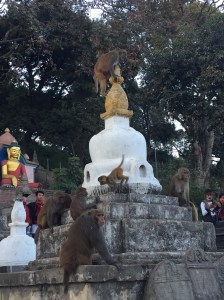
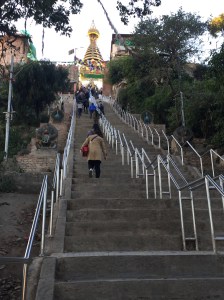
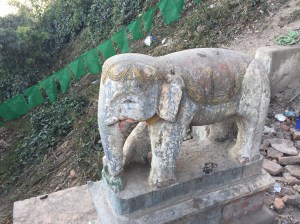
One afternoon back in KTM we walked the 2 kilometers – just over a mile, to see Swayambhunath Stupa, nicknamed the ‘monkey temple’ for all the rhesus macaques who inhabit the area. It was worth climbing the long staircase for the views at sunset.

IMG_9678 IMG_9677.jpg IMG_9680

IMG_9683.jpg IMG_9681 IMG_9686

We also enjoyed two more dinner dates with our special friends from Shanghai this week. They had returned to Kathmandu to prepare for their flight home, and, we already know that they arrived in China, safe, and to a cooler time of the year.

IMG_9711.jpg

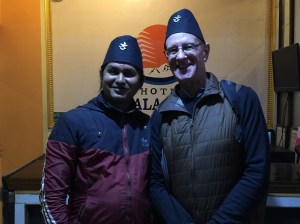
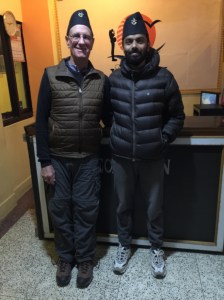
Otherwise, we have spent the week laying low, planning our next trek in Kathmandu Valley, and preparing for more of the next months of our Journey. We are enjoying our time here. We have neat hotel co-owners, who gifted Loren and all their staff with a Nepali style hat. And, we have the best room – we know so because this week when we asked to  move back to it, the staff confirmed, everyone asks for Room 405. It has a south facing wall with double windows, which helps it feel cheerful and also keeps it warm.

IMG_9659.jpg IMG_9661.jpg IMG_9662.jpg

Finally, this week I just had to snap a photo at a restaurant where we have eaten some of our meals, the image on their wall captures our Journey for me.

IMG_9657.jpg


Week 192 December 2, 2017

After returning to Pokhara from our Poon Hill trek, we visited Helping Hands spa for a massage – this is a place where people who are deaf and blind work, and we especially enjoyed our massages knowing that we were supporting this community. Afterwards, we made a short hike up to a giant gold Buddha tribute, nestled on a hillside behind town.

IMG_9245.jpg

We met our newest friends from Shanghai who stayed at our same AirBnB. They are on their marriage trip and had just returned from a trek the day after us. The husband is Chinese and the wife is originally from Kyrgyzstan. Lucky for us, they speak English very well. In fact I also want to express my gratitude for all the people – both locals and foreigners who we meet as we travel who speak English, which makes our Journey so much easier to navigate and more fun. We enjoyed several conversations in the common area of our AirBnb home together and, as they too were heading to Lumbini the day after us, we exchanged emails and made plans to meet up there. We then bade our beautiful, kind, family hosts farewell, and took our 8:30am Tourist bus to Lumbini.

IMG_9270.jpg

This bus was the fastest we have ever ridden on such a long, bumpy and curvy road. Our driver had brakes squealing and horn honking nearly all seven and a half hours. We were told it would be a six to seven hour trip, I wonder how long it would have taken if he had had gone slower? But he was adept and we arrived safe and sound.

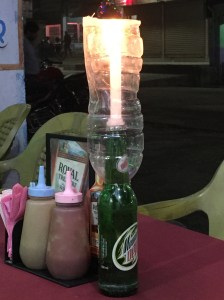
Between congregating before departure and during three brief rest stops, we noticed some of our fellow Tourists. Once in Lumbini, we would recognize each other as the tourist area in town is small and we took meals at the same restaurant that served food prepared with safe water for Tourists. The restaurant has a creative Earth friendly way of providing candles on each table. Here we shared a few chats with couples from France, and the couple who we talked with the most – beginning on the bus, were from Bangalor, India. These two are platonic friends and retired co-workers. He had been on a long trek before she joined him in Nepal for to visit other parts of the country. 

IMG_9274.jpg

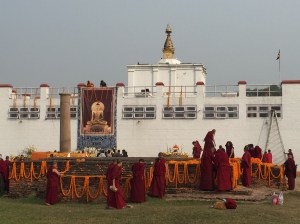
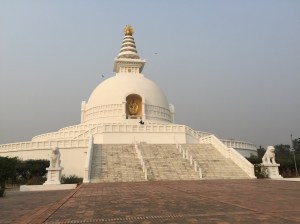
Lumbini is birthplace of Prince Siddhartha Gautama, who during his lifetime became the Buddha or Shakyamuni Buddha. The name Shakyamuni or Sakyamuni is a tribute to Shakya or Sayka, the name of the tribe into which he was born. We learned the sweet story of how Queen Maya, dreamt of an elephant under the full moon, which announced Siddhartha’s conception. Later, while on her journey to deliver the baby in her parents home which was tradition, she stopped in Lumbini to bathe. This is where she felt her labor come on. This site, reported “lost for centuries,” is now a vast park. It has a very long, central mall, with most of that designed for water deep enough to allow for boat shuttle. It includes an eternal flame at the Maya Devi end – the actual birth site, and a Peace Pagoda at the far other end.

IMG_9338.jpg IMG_9349.jpg

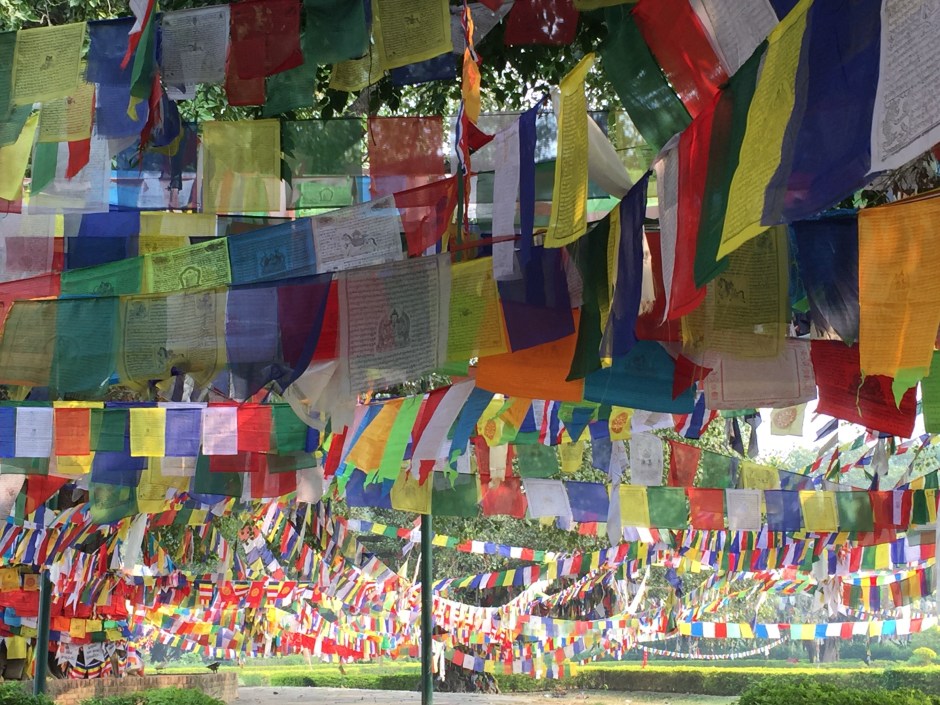
Monasteries, temples, pagodas, stupas, meditation centers, a museum, and other offerings built by Buddhists from different countries are situated on either the eastern or western sides of the mall. Loren and I rented bicycles to visit many of these sites. We began at Maya Devi where we saw the largest tribute of prayer flags imaginable. I learned how the colors in the flags represent 5 elements: yellow for the earth, green the water, red for fire, white for air, blue for sky.

IMG_9329.jpg

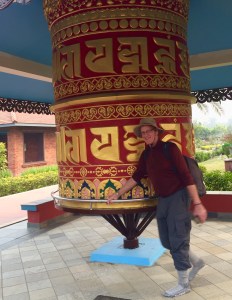
Finding all the memorial sites was a bit challenging given the park size and layout, and poor maps to little signage, so we visited the ones we could find in random order. On our first day we only had time before dusk to see temples built by Buddhists from Singapore, and another for Germans, where Loren spun one of their four giant prayer wheels.

IMG_9360.jpg IMG_9376.jpg

We had met our Bangalor friends in passing a couple of times during that first day. When we saw them at the side of the boat dock at the end of the day, we learned that she had taken a fall. Her friend appeared unable to comprehend that she could not stand or walk on her left leg due to severe pain, and she remained seated on the bench that the locals had provided for her. It felt fortuitous that we could help a little. Thankfully a rickshaw was readily available to take them to their hotel, across the street from our restaurant in town. We settled in there for a beer after following them back. At the hotel, she was attended by a doctor who referred her for an x-ray in the larger city of Butwal. While she and her partner, who was more solicitous to her needs sorted their belongings, I had a meaningful conversation with her before their taxi arrived.

The next day, Loren and I visited the Sri Lanka site, a monastery devoted to International Nuns, the extensive Myanmar site, and the tributes from Cambodia, India and Thailand.

IMG_9405.jpg IMG_9407.jpg IMG_9417.jpg

IMG_9430.jpg IMG_9433.jpg IMG_9438.jpg

We had planned to stay 3 nights in Lumbini, and on the recommendation of our hotel owner in Kathmandu, had hoped to spend one night at one of the monasteries. However, easily finding someone to talk with about that possibility never materialized, so we abandoned the plan to cycle around during the days and sleep at our hotel. Near the end of our last full day though, we befriended a Monk at the Swiss/Austrian monastery, with the grand name, The Mother Temple of the Graduated Path to Enlightenment. Loren then resurrected the plan and soon we were rearranging hotels, bus, dinner date, and bicycle hire, to return to a guest room there overnight. We joined in their meditation and prayers, fulfilling meals, and, gained a much better understanding of Buddha’s life and the concept and practice of Buddhism while there.

IMG_9556.jpg

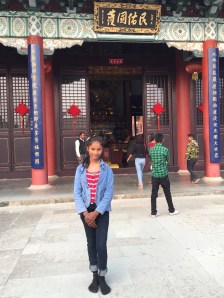
The next day we learned that our friends from Bangalor had flown by helicopter to Kathmandu, and were intending to soon return to India by plane. I am keeping her in my heart for a full recovery. Loren and I set off on this day to see the temple of Vietnam – where we saw two Sarus cranes – the largest in the world, and tributes of Nepal, France (not pictured), and China. Loren decided to forego this last site, feeling a little “templed out” but more so wanting to avoid the crowd, and a young Nepali girl engaged me here. 

IMG_9558.jpg IMG_9605.jpg IMG_9619.jpg

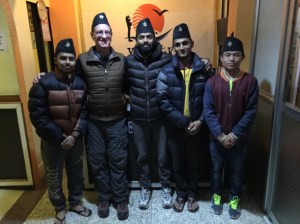
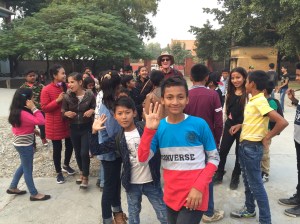
When I returned to join Loren at our bicycles, I saw a peaceful mob of Nepali children.  It turned out that they were all gathered around him! So much for avoiding a crowd. These youth too were visiting the temples of China, then Korea, and were enthusiastic to walk and talk with us. In fact, several adult Nepali have also sought us out in Pokhara and Lumbini to talk and take selfies. While we snap our photos to remember what we are seeing, we are also being photographed – sometimes obviously, sometimes slyly. It seems they want to remember us, for our novelty in their culture.

IMG_9624.jpg IMG_9628.jpg